Toddler Growth and Development
Toddler growth and development refers to the cognitive, language, physical and social/emotional developmental stages toddlers go through.
Let’s talk about how these areas progress as they grow!
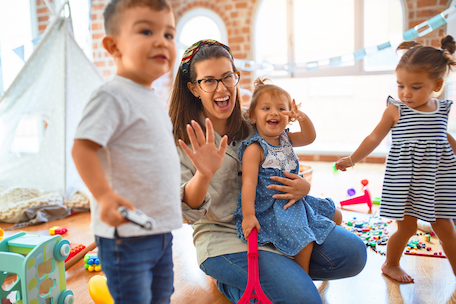
First, let’s define what the toddler years are!
The word toddlers refers to a children between the ages of 18 months and 36 months old. Many early childhood programs designate classrooms for younger toddlers (ages 18-24 months) and older toddlers (24 months to 3 years old).
The preschool years begin at age 3 (if you teach preschoolers, you’ll want to check out my Preschool Plan It website found here).
This site, Toddler-Plan-It focuses on older toddlers (ages 24-36 months).
While some toddlers may be reciting the alphabet at age two, others may not do that until they are 3.
While some toddlers may be talking in full sentences by age 2, others may be speaking in phrases or incomplete sentences at the same age.
Why such discrepancies?
The reason is that all children grow and develop, for the most part, in the same order but go through the stages at their own pace.
As Early Childhood Educators, it is our responsibility to know the stages children go through at different ages.
Parents tend to compare their children to other children they know of the same age. This can put much pressure on them and, by extension, on their children to “perform” certain skills that they just aren’t ready to do yet.
Your solid understanding of toddler growth and development will help you to share that knowledge with parents about these stages and help them understand that there can be 6-8 month (or more) window of discrepancy meaning—their child is right where they should be!
Knowing the stages children go through during the toddler years will help you to plan activities in two ways.
1. It will help you to plan activities that are developmentally appropriate for the toddlers in your classroom.
2. It will help you plan for the appropriate level of development for each of your toddlers are in.
Toddler growth and development includes many overarching areas or domains of child development. They include:
Physical Development
Social/Emotional Development
I say they are ‘overarching’ because many activities help toddlers develop in many areas.
For example, let’s say you overhear one toddler saying to another toddler,
“Your shoes are purple. I like purple.”
This requires the use of words (language), color recognition (cognitive) and talking to another person about a topic (social/emotional).
Let’s break down the basics of the four main toddler growth and development domains.
Toddler Growth and Development: Cognitive
Cognitive development refers to a child’s ability to communicate as well as solve problems in their world as they explore it and think about it.
They use their observations and skills to develop more abstract thinking about the world around them as they interact with the materials in the classroom and as they talk with their peers and the adults in their space.
Their cognitive development skills help toddlers try new tasks as well as new challenges or problems they approach and also helps them to join in and cooperate with others while playing and learning.
Toddler Growth and Development: Language
Toddler language development refers to learning and speaking language as well as their understanding of the spoken word, how to communicate and how to express themselves to others.
Their language development skills help them in communication with others as well as helps them with behavior management and helps improve their own self-regulation skills.
Toddler Growth and Development: Physical
Toddler physical development refers to the development of both their gross (large) muscles and motor skills as well as their fine (small) muscles and motor skills.
Gross motor skills refer to large muscles and how they help toddlers move their bodies and interact in their space.
Fine motor skills refer to the smaller muscles (such as their fingers and wrists) to explore and use smaller materials such as a small ball, a crayon and more.
Their physical development is crucial during the toddler years in order for them to have physical balance while standing, walking or running as well as learning how to grasp, toss and throw items and balance as they walk.
Toddler Growth and Development: Social/Emotional
Toddler social/emotional development refers to the abilities to interact with others in appropriate ways while learning to consider the social and or emotional needs of others.
Their social/emotional development allows them to learn new things with confidence, develop healthy self-esteem, observe and consider the emotions of others and build positive relationships with others.
Toddler Growth and Development Summary
Your toddler classroom is an environment that supports all areas of toddler growth and development.
The interactions and materials you provide help them grow and develop in these areas. Knowing toddler growth and development basics will help you to provide what they need.